- Home
- Government
- County Government
- Board of Commissioners
- Legislative Priorities
Legislative Priorities
The Clay County Board of Commissioners have adopted the following legislative priorities for the 2025 legislative session.
Background
Minnesota faces a significant shortage in the continuum of care for children with high-acuity, complex, or cooccurring conditions, including violent or sexually inappropriate behavior, as well as physical or mental health challenges. As a result, many children are being placed in inappropriate settings such as acute care emergency departments, juvenile detention facilities, county offices, and even hotels due to the scarcity of available resources for the necessary care and treatment.
A March 2021 article in the Minnesota Physicians Journal indicated “Minnesota ranks 50 out of all states on having the fewest number of psychiatric beds per capita (3.5 beds per 100,000)”. An article in The Minnesota Star Tribune October 2024 stated that, “281 kids were referred for placement in the four such facilities (PRTFs) in the state, according to Department of Human Services (DHS) data, but only 66 got in.” “While the facilities are licensed for 150 kids, they were only serving 85 as of June,” according to the therapeutic provider association AspireMN.
Strategic Plan
Clay County is proposing to convert the current Non-Secure Juvenile Facility (NSJF) into an 18-bed PRTF. The facility meets the requirements for a 6-bed secure unit, which no current PRTFs in the state of Minnesota can provide. The DHS officials have already inspected the facility and confirmed that it is well-suited to function as a long-term PRTF. Because the facility was renovated in 2019, it will only need minimal cosmetic changes to repurpose the space. It is durably constructed and robust enough to safely accommodate the wear and tear that comes with therapeutic and residential use.
With the proposed conversion, it will enable the creation of a new, more cost-effective NSJF on an adjacent county-owned lot. The NSJF does not require the same security and detention grade materials as a PRTF, so the construction of a new NSJF is significantly more affordable than constructing a new PRTF. The non-secure program is critical and must continue serving youth who require that level of service.
Support
Clay County has a strong reputation for providing care and services to at-risk youth. The proposal has garnered significant support from 29 counties, 5 cities and all 11 Tribal Nations across the state. With this backing, the county seeks to partner with Solutions Behavioral Health to bring PRTF services to both the region and the broader state.
Proposed Facility
The proposed new Non-Secure Juvenile Facility would be a 40-bed facility capable of housing both male and female juveniles. The building would contain two (2) 8-bed housing units licensed by the MN Department of Corrections as Non-Secure Children's Residential Facilities capable of accommodating trauma informed QRTP. The building would contain two (2) 8-bed housing units licensed by the MN DOC as Non-Secure Children's Residential Facilities for transitional living. The building would also contain two (2) 4-bed housing units licensed by the MN DOC as Non-Secure Children's Residential Facilities with additional DOC security services. The facility will be licensed to serve youth ages 10-21 in all units and provide 24-hour supervision. Additional programmed space is included for food preparation, laundry, therapy, education, recreation, visitation, and medical services.
Mission
The mission of Clay County West Central Regional Juvenile Center is to provide “a learning environment where the values of each individual are recognized, developed and matured for the betterment of our community.” The vision is “Through accountability, education, and community involvement, a valued future awaits.”
Clay County Request
Clay County is requesting $28,380,000 in funding for a new Non-Secure Juvenile Facility so the existing facility can be transformed into a PRTF to serve youth from the West Central and Northwest regions of Minnesota.
- 2025 Senate File: SF 1795
- 2025 Legislative House File: HF 1266
- 2025 Legislative House File: HF 1380 (startup funding)
Flood Risk in the Red River Valley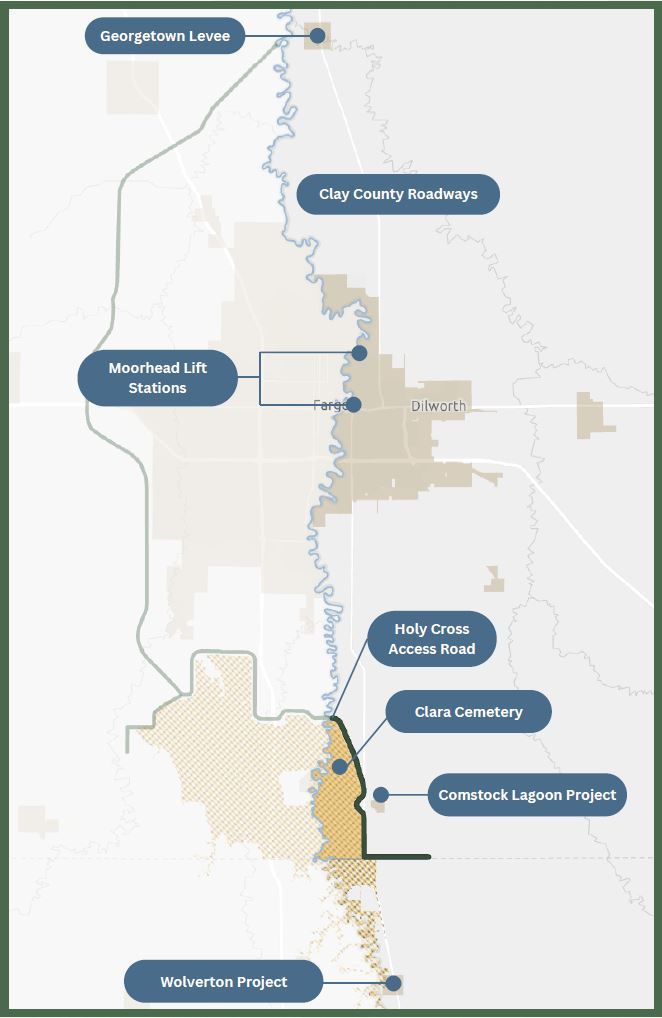
The Red River is unique due to its low gradient and northward flow. These features also lead to a high flooding risk. Ice melt comes earlier in southern regions, causing ice jams and other conditions that result in flooding nearly every year. This makes the Red River Valley one of the most flood-prone areas in the U.S.
Project Overview
Water flows downstream, passing through the natural riverbed, which is bordered by in-town levees and floodwalls. If the flood level will exceed 37 feet, the Metro Flood Diversion Authority (MFDA) will prepare to operate the FM Area Diversion. Radial-arm flood gates on the Red River Structure and Wild Rice River Structure are lowered to limit the amount of floodwater that enters the metro area. A portion of floodwater moves into the upstream mitigation area, where it is temporarily stored within the southern embankment. Gates open on the Diversion Inlet Structure, allowing floodwater to enter the stormwater diversion channel and safely pass around the metro area. Once project operations end, the MFDA will remove flood-related debris from the upstream mitigation area.
Clay County Request
To construct the remaining flood mitigation infrastructure in Minnesota, the City of Moorhead and Clay County request funding from the Minnesota Department of Natural Resources’ (MN DNR) Flood Damage Reduction Program in the amount of $60.4 million. The funding requests would be used to complete the remaining components within the City of Moorhead first.
911 Fees
Per Minnesota Statute § 403.11 Subd. 1 Emergency telecommunications service fee; account: (a) Each customer of a wireless or wire-line switched or packet-based telecommunications service provider connected to the public switched telephone network that furnishes service capable of originating a 911 emergency telephone call is assessed a fee based upon the number of wired or wireless telephone lines, or their equivalent, to cover the costs of ongoing maintenance and related improvements for trunking and central office switching equipment for 911 emergency telecommunications service, to offset administrative and staffing costs of the commissioner related to managing the 911 emergency telecommunications service program, to make distributions provided for in section 403.113 , and to offset the costs, including administrative and staffing costs, incurred by the State Patrol Division of the Department of Public Safety in handling 911 emergency calls made from wireless phones.
Clay County Fees
A fee of $0.80 per month is collected from every device that is used by Clay County residents. The fees that are collected go into Emergency Communication funds. Clay County receives a portion of the fees back and the rest is distributed to maintain a special revenue account, the Allied Radio Matrix for Emergency Response (ARMER) system, and unallocated funds.
Having access to the remaining unallocated funds would give Clay County the opportunity to address the emergency response needs in our communities.
Clay County Requests
Clay County is requesting access to the unallocated funds remaining from the 911 fees collected from Clay County residents.